

A unique opportunity
for a new blockbuster drug
Pain and its treatments
Pain is the most widespread medical condition worldwide: everyone will, at some time in their lives, need to use a painkiller.
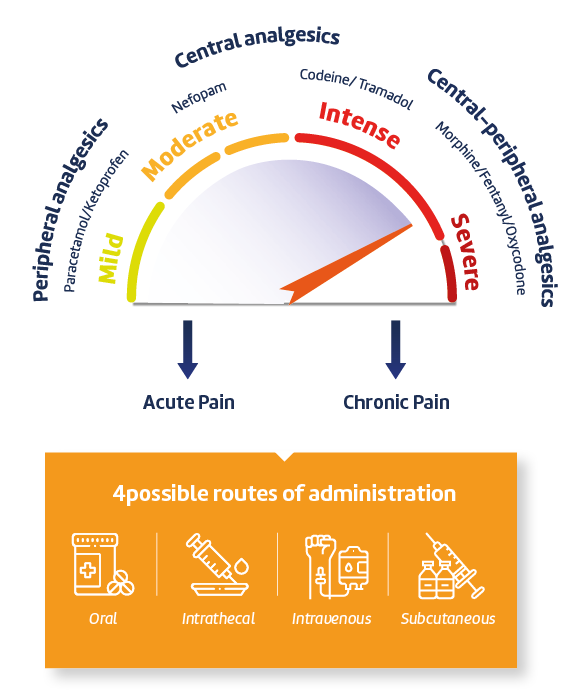
Pain manifests in physical, emotional and psychological forms. Depending on its persistence over time, it is generally classified as acute or chronic. Acute pain is of short duration and plays an essential role in ensuring our physical integrity, whereas chronic pain persists beyond the normal period of healing and has a deleterious effect on our well-being.
Pain can also be classified according to its severity: mild, moderate or severe. Mild pain is usually treated with painkillers such as paracetamol. More intense pain requires the use of stronger analgesics, principally opioids.
Unmet medical needs at the root of
a worldwide health crisis
Without effective treatment, pain can have major effects over and above immediate discomfort: sleeping problems, depression and social isolation. More importantly, inadequate treatment can lead to the development of chronic pain — which affects 20% of the world’s population and is the underlying cause of two thirds of medical consultations — currently constituting a considerable economic burden, almost 300 billion Euros in Europe alone.
The serious adverse effects of current drugs
But the challenge we face does not stop there: the treatments offered to patients over the last 20 years have serious adverse effects, which have led to a worldwide health crisis. Mild pain is generally treated with analgesics such as paracetamol or certain anti-inflammatory drugs with severe adverse effects if misused.
For more intense pain, more powerful analgesics are required, principally opioids (accounting for almost a third of the global painkiller market), which have immediate adverse effects and are associated with a high risk of dependence, overdose, and even death.
Consequently, many patients refuse to take opioids, preferring to put up with the pain, which generally slows complete recovery. Certain antiepileptic drugs currently used in the treatment of neuropathic pain can also be misused or abused.
There is an urgent need worldwide to develop alternative solutions for pain management. This is the mission of Tafalgie Therapeutics.
14 million

French people
complain of chronic pain
1/4

of whom suffer
from neuropathic pain
100 million

patients in Europe
have chronic pain
1,5 billion

people
are confronted
with persistent pain.
Living with Pain: A Global Reality for Billions
14 million people in France complain of chronic pain and a quarter of these people suffer from neuropathic pain. In Europe, an estimated 100 million patients suffer from chronic pain and, according to the WHO, one and a half billion people are confronted with persistent pain.

Pain is at the center of a world health crisis: the famous “opioid crisis”
Opioids are widely used powerful analgesics. However, in the United States, dependence on opioids has escalated out of control, leading to an “opioid epidemic”.
Indeed, the increase in opioid prescription by doctors over the last 20 years has led to a generalized misuse of opioids delivered on prescription and on sale over the counter to such an extent that the HHS (the US Department of Health and Human Services) declared a public health emergency in 2017 (HHS, What Is the US Opioid Epidemic, 2021).
The situation in France and, more widely, in Europe is not comparable, thanks to strict controls over the prescription, delivery and management of these drugs, and the information delivered to healthcare professionals and the general public.
Nevertheless, over the last few years, a small net increase in the use of opioids has been observed.



A unique opportunity for a new blockbuster drug
The principal issue is that current treatments for pain have serious adverse effects. Some even present risks to health exceeding their estimated benefit in terms of pain relief.
There is, therefore, an urgent need to develop new solutions, based on innovative approaches, for pain treatment and management.
The technology developed by Tafalgie Therapeutics provides a perfect response to this need. Thanks to its mode of action, which is fundamentally different from that of all current treatments, it can stop the propagation of pain in the nervous system without the development of tolerance phenomena or toxicity.